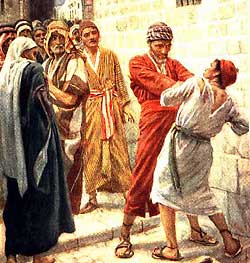
Showing posts with label forgiveness. Show all posts

Sunday, December 2, 2018

Love Your Enemies

Jesus taught that we should love our enemies and pray for them.  He taught we should turn the other cheek.  Jesus practiced this to the extreme when he allowed himself killed by his enemies and prayed for their forgiveness at the very moment they were killing him on the cross.  How difficult we have found it to practice this in our own lives.

The political atmosphere today is a perfect example of how we fall short of this everyday.  I used to pay close attention to the news, and prided myself in my knowledge of current affairs.  The divisiveness of the 2016 presidential campaign turned me away from the news and social media.  I could not tolerate all of the hate and negativity I read on a daily basis coming from both sides of the political aisle.  It is as bad two years later.  

I, for one, find it easy to love those "enemies" of mine I have no personal contact with.  Whether it's politicians, celebrities, or facebook friends who I disagree with, or people who are blatant opponents of mine, if I have no personal connection to them I have no problem praying for them and turning my other cheek.  However, when it comes to people I have direct contact with on a regular basis, I have a very hard time turning the other cheek.

There is a person in my life with whom I have had a very adversarial professional relationship.  I have felt unjustly criticized by this person.  Frankly, this person has never liked me much.  Sometimes no matter what we do, there are people we encounter who we just rub the wrong way.  I have done what I could to keep this relationship amicable, but it is now at a point I can no longer continue my relationship with this person.  

I keep thinking of all the possible scenarios that might result when I tell this person I am breaking off our professional relationship.  I imagine how good it would feel to tell this person off to his face.  I imagine the nasty things he might say to me, and how I might give back a stinging retort.  There is a lot I could say to him to call him out on his hypocrisy and unjustified criticism.  But what good would that do?

It might make me feel good for a short period of time to be nasty to him for once.  But in reality, it would not serve him or me good in any way.  He will not change or apologize because of my criticism of him.  It would do nothing but lower me to his level.  How much better would I feel leaving as the better man?  I will break off our professional relationship by thanking him for all he has given me during our professional relationship.  I will shake his hand.  I will do everything on my part to live up to the call of Jesus to love our enemies, to turn the other cheek, and to pray for him.  I will wish him well.  I will be the better man.

Sunday, April 29, 2012

Your Sins Don't Matter, You Do!

Today I want to share with you a beautiful story of the value Jesus gave someone who was otherwise criticized for her behavior. The story can be found in Luke 7:36-50 of a woman who was called a sinner, and likely was a prostitute, who came to a meal Jesus was having with a Pharisee and anointed his feet with her tears. The response from the Pharisee was one of condemnation as he said, "if this man was a prophet he would know what kind of woman this was he was letting touch him." The Pharisee immediately condemned the woman, whereas Jesus provided her with value. His response to the Pharisee was to share a story of two debtors, one who was forgiven a small debt and another who was forgiven a large debt. Jesus asked the Pharisee, "who loves more, the one forgiven a little or the one forgiven much." Of course the Pharisee's answer was the one who was forgiven much. Jesus continued by praising the prostitute's faith.

What I love so much about this story is how Jesus took a woman that was ridiculed and condemned by the religious establishment of his day, and instead provided her with value and worth. You see, that is what Jesus did. When he saw someone who was hurting emotionally or was alienated by the religious authorities, he accepted them and welcomed them into his circle where they received love and were shown a worth that they had never experienced before. We read of Jesus eating with tax collectors and sinners who were rejected by the religious elite. We read of Jesus sitting down and listening to a Samaritan woman who was criticized by her community for living with a man out of wedlock. Jesus forgave an adulteress woman who the religious elite were ready to kill, and he touched lepers whose community made to live outside the city limits. Jesus never rejected a single person he encountered, but instead brought them acceptance and love, no matter what their position was in society. Whereas the religious leaders in Jesus' time would consistently take away from the worth of others, Jesus consistently provided worth to everyone he interacted with.

What we can gain from this story is two-fold: first, you are valuable as a human being. Nothing you do can take value away from you. Your worth is based on the fact that you are part of God's creation and has nothing to do with successes or failures you have committed. Your value is safe and secure in Jesus. So when you are feeling like you have done something wrong and are feeling guilty, just know that Jesus forgives you and values you immensely. As difficult as it is to forgive ourselves sometimes, it is something we have permission to do because God forgives us without any questions asked. If you are uncertain about this, just look at the many people Jesus forgave without any hesitation. Let me say it again, you are valuable as a human being no matter what.

Secondly, we are to show people that same worth that Jesus shows us. That means when we see someone who has sinned, or who we perceive to have sinned, it is our duty not to condemn them or shun them as the Pharisee did with the prostitute. Instead our duty is to show them the forgiveness, love, and value that Jesus showed the prostitute. That means instead of judging women who have had or are contemplating having an abortion, we should show them love and acceptance. That also means that if you view homosexuality as a sin (something I myself do not) you treat them as forgiven and accept them just as Jesus would have and does. It does not matter what other people do or what their background is. It does not matter what another person's faith is, we treat them as Jesus would have: we accept them. That is what Jesus did.

Thank you, and don't forget to stop by amazon.com where you can purchase a copy of my book What Did Jesus Do: Using Jesus' Interactions in Scripture as a Basis for Our Interactions Today, for kindle. Again, thank you and God bless.

-Brandon

Wednesday, June 15, 2011

Parable of the Unforgiving Servant: A Reinterpretation


I had a good response from my contemporary interpretation of the parable of the Good Samaritan, and so I thought the need for this kind of biblical study was enough that occasionally I would write up a modern interpretation of the original text. Understand that as I do this, my intention is not to replace the original message or to somehow say that my translation is superior. Instead, my intent is to take a passage that uses illustrations that will no longer make sense to most readers (as they are very tied to their cultural setting) and modernize them so that perhaps we can have a better understanding of what Jesus is asking us in these parables to do today. With that said, let's now look at my modernized translation of the Parable of the Unforgiving Servant which can be found in Matthew 18:21-35.

The kingdom of heaven can be compared to a lender who wanted to settle accounts with his borrowers. He brought in a man who still owed $200,000 on his home, even though his home was not even worth that amount any longer. Due to the recent decline in the economy, this man lost his job and was currently making slightly less than $20,000 a year at the only job he could find. He was behind on his payments and was facing foreclosure if he didn't pay $40,000 by next month. The lender called this man in and was told by this man that he didn't even have $4000 to give the lender. The lender, furious, called for the immediate foreclosure of this man's house and told him that if he didn't come up with the money in the next two weeks, he would take this man to court and seize all of his assets. The man immediately fell on the ground and begged, crying for a little more time, promising to pay the debt. The lender, having compassion on this man, forgave his entire debt and allowed the man to own the home outright.

This man left the lender feeling incredible relief and joy at having been forgiven such an incredible debt that would have been impossible for him to pay off in his own lifetime. This man also had a renter staying at his home who had been living there for the last two years and never missed a monthly rent payment until two months ago, right after he had lost his job. This man went directly to his renter and demanded that he pay him the two months rent. The renter pleaded with this man, asking for a couple more days to come up with the money. But the man immediately evicted his renter, called the creditors to seize the rent from his accounts, and got a restraining order so the renter could not come into the house to get his property.

When the man's forgiving lender found this out, he immediately called the man into his office. "I forgave you an impossible debt to repay," he exclaimed, "and yet you cannot even forgive a small debt? You will regret this." He immediately reissued the debt, tripling the interest rate and doubled the amount the man owed by next month. The lender also froze all of the man's assets until the debt could be fully repaid.

Jesus finishes up the parable by saying, "My heavenly Father will also do the same to you, if each of you does not forgive his brother from your heart.” This parable teaches us that the debt (the sin) each of us are forgiven by Jesus, is greater than anyone of us can repay in a lifetime of effort. Nothing we can ever do can ever repay the debt we have incurred due to our sin. That is why Jesus died on the cross, providing the forgiveness of our debt. Therefore, it is wrong for us to be unforgiving of the sin of others. We should be forgiving of the sins of others because no sin anyone has committed is ever as great as the sin we are forgiven in our own lives. This should make us pause and think about what we are doing when we are judging another person of their sins. We are saying that since their minuscule sin should not be forgiven, then neither should our great sin. But since God is willing to forgive us of our own sin, we should be willing to forgive others of their sins.

Finally, this parable also teaches us that we are misinformed regarding the sin of others. Often we exaggerate the extent of others' sins, making them greater than they really are. Either that or we make something a sin that is not really a sin. For these reasons also, we need to be forgiving of the sins of others. Otherwise we risk losing the incredible forgiveness we are offered from Jesus. What you consider a sin, may not be considered so bad by God. So if you are met with someone who does drugs or drinks to excess, if you meet a homosexual or someone who has had an abortion, if you meet an illegal immigrant or someone who is covered in tattoos, treat them as Jesus has treated you, with the utmost of compassion, love, and forgiveness. That is what Jesus did.
Blessings,
-Brandon

Monday, June 6, 2011

Anthony Weiner and Jesus: The Biblical Response


When big events occur in our time, I often wonder how Jesus would have responded. When I see church leaders on TV proclaiming the message to repent, I wonder what Jesus would say to them today. When athletes outspokenly thank God for their superstar performance, I wonder what Jesus might have to say to them. And when politicians are caught in a scandal and our leaders fall, I wonder if Jesus would be condemning of them or merciful.

Just about everyone in the United States is familiar with the scandal surrounding New York representative Anthony Weiner. Today he admitted having sent lewd photographs of himself to a young woman over twitter, one of many it turns out he has sent over the previous few years. In the weeks since the tweet was made (publicly instead of privately like he had intended) he lied to several media outlets, claiming his twitter account had been hacked and that he had not sent the tweet.

Monday, May 16, 2011

Christian Hypocrites


One of the most common critiques of Christianity about its adherents that I hear coming from the mouths of detractors is that "Christians are hypocrites." Christians, of course, are aghast at being called hypocrites, thinking our antagonists are claiming that we continue in our sin when we adamantly admonish the sins of others. This may be where some of the criticism comes from, however I believe there is a lot more to it than that, and that Christians are completely blind to why others are calling us hypocritical.

The term "hypocrite" comes from the ancient Greek and was the term used for an actor. A hypocrite was one who put on a mask and acted in the Greek dramas or comedies. A hypocrite has therefore come to be known as someone who is putting on false airs about them. It is someone who acts in a way opposed to who they really are.

Therefore, it does not seem to me that we Christians are being accused of hypocrisy for admonishing sins in others while we are being sinful ourselves. One thing Christians are really good at is admitting our own sinfulness. (Admittedly, we are also really good at pointing out the sins of others also). What would be hypocritical is claiming ourselves to be perfect (putting on the air of perfection) when in fact we were out lying, stealing, cheating, and doing all kinds of sordid behavior. But this is not what is going on. We admit our sinfulness while also admonishing the sins in others, which is not what makes us hypocritical. So what do we do as Christians that others see as so hypocritical?

Christians are hypocritical in that while claiming God's grace for ourselves, we neglect it when it comes to other people. We consider ourselves to be saved by the grace of God, while withholding his grace from others when we see them as sinful. Even though we claim God's grace for ourselves, affirming that "even though I am still a sinner I know that God's grace provides me with forgiveness and salvation anyways," we deny it to others who we perceive to be sinners, such as homosexuals, illegal immigrants, those who have had abortions, and so on saying that they cannot be part of the body of Christ and be saved without first giving up their sinful behavior. How can I affirm God's salvation apart from works for me while denying it to another who I think is a sinner? I cannot do this without appearing the hypocrite.

But maybe you will say to me, "how is this putting on an air? How is this acting in a way opposed to who we really are?" This hypocriticism takes place in two ways. First off, we are putting on the air that others cannot receive salvation without first putting an end to their sin. The foundation of Christian doctrine is that we are sinners and need God's grace apart from our works to save us. So when we tell "sinners" that they need to stop sinning (which is usually what we wrongly mean by "repent and be saved") we are acting in a way opposed to who we really are. We make the claim that we are so unworthy and need Jesus' free forgiveness to save us, and then demand others to save themselves before Jesus can; this is hypocrisy.

The second way in which this is hypocrisy is that when we claim grace for ourselves while denying it for others, we are really denying grace for ourselves also. If I make the claim that I am saved freely by the grace of God, but ask another person to change before they can enter into the body of Christ or be saved, I am really hindering God's grace to work in my life. I said in the previous post, To Be Forgiven, We Must Forgive that we are told by Jesus that if we do not forgive another, God cannot forgive us (Matthew 6:14-15). In the same way, if we do not show grace and acceptance to others, we do not allow God to show us grace and acceptance. Therefore, when we claim for ourselves grace while denying it to others, we are really putting on an air of grace that we in reality are denying to ourselves.


So how do we end this hypocricy of ours? The first thing we must do is to truly experience the infinite love and unconditional acceptance Christ has for us. When we can truly look at ourselves and the things we have done, and can see that God still forgives us, even when we are continuing on with our bad behavior, we can come to a full understanding of God's awsome compassion. Having done that, we then need to practice having that same compassion for others, doing our best to show them the unconditional love and acceptance that Jesus has for us. If this is a struggle, make this issue a part of your daily prayers to God. It is too important of an issue not to pray about. Maybe if we can all practice this in our lives, we will no longer be seen as hypocrites, but as genuine and loving people who provide support and comfort when no one else will.
Blessings,
-Brandon

Friday, May 13, 2011

To Be Forgiven, We Must Forgive


"And forgive us our trespasses as we forgive those who trespass against us...For if you forgive others for their transgressions, your heavenly Father will also forgive you. But if you do not forgive others, then your Father will not forgive your transgressions."

These are some of the hardest words of Jesus for us to accept as Christians. They are difficult because it not only means forgiving our family and friends for minor offenses such as lying, breaking promises, or calling us names, it also means forgiving those we consider our enemies for offenses we consider outrageous and terribly sinful. It means that we no longer let their offense bother us no matter how wrong their action or behavior. It means considering themselves reconciled to us, even when it seems unfair. This seems especially difficult when we are asked if we must forgive Hitler or Bin Laden for their misdeeds. Let me assure you that forgiveness does not mean forgetting, or, if someone's offense is a crime, letting them off Scott free (who is Scott and why is he free anyways). If someone is killing people or molesting children, they need to go to prison for obvious reasons. Forgiveness is letting go of the hold another person's offense has on you. Lewis Smedes puts it this way, “You will know that forgiveness has begun when you recall those who hurt you and feel the power to wish them well.”

What we learn from the above words of Jesus is that in order to receive forgiveness, we must forgive the sins of others. He is very clear, if we do not forgive, we will not be forgiven. So what does forgiveness look like?

I am not going to address forgiveness for major crimes or criminals in this post because I do not think that is the most difficult area of forgiveness for Christians. I think the most difficult area of forgiveness for Christians is forgiving what we perceive to be sin, even minor sin, in other people. Premarital sex is no crime, but how difficult is it for us to forgive such an offense. If the Church finds out the youth pastor has been engaging in premarital sex with his fiance, he gets relieved of duty. Even though the plan is to for the couple to get married, and even when the youth pastor is repentant, we cannot forgive even though God does.

If we find out one of the ladies in our bible study has had an abortion, it is all over, she will be run out of that bible study so fast no one will know what happened. She may be feeling devastated about the abortion. She may be repentant every day and forgiven by God. But she is immediately and forever condemned by us.

If two women walk into the Church holding hands, we stare viciously at them and, like a scene from Forest Gump, tell them "this seat is taken," even though no one has sat in that pew for twenty years. (For those wondering, I continue in the idea that homosexuality is not a sin, and will continue to lead people to my post Is Homosexuality a Sin? as long as I am alive. But the majority of Christians will continue to think of homosexuality as a sin, and so I am speaking to them from their world-view). These women are forgiven of their sins by God, but not by the body of Christ.

We are told in Scripture that the gate to heaven is narrow. I do not think this is because of the vast amount of sinners there are in the world. I think it is because of the vast amount of grudges people hold. I think it is because even Christians are not willing to forgive people of their sins unless they are their own. I think a large amount of Christians will not enter into the kingdom of heaven because they are not willing to forgive people for what they perceive to be sin (not everything Christians condemn as "sin" are really sins in the Bible. Many churches consider long hair on women to be a sin, while other churches consider short hair on women to be a sin. Some churches consider smoking to be a sin. Some consider drinking alcohol to be a sin. None of these things are in fact sins in the Bible). If the Church continues in its lack of forgiveness, that gate will be much narrower than we ever thought.

Jesus commands us to be forgiving. This means that we will not let it bother us if a Christian is struggling with sin. Show me a Christian who is not struggling with sin. And if you come forward telling me about how above reproach your pastor is, my guess is he or she would be relieved of duty if his/her sins were found out. No Christian is free from sin...that is unless we practice forgiveness.

You see, Jesus died on the cross, he paid it all because our debt was too great to pay. The only way to sever our debt was to provide a way for that debt to be forgiven of us, instead of paid by us. And if God can forgive us of our sin, shouldn't our appreciation be shown by forgiving others of their sins. To illustrate this, Jesus tells this parable in response to a question from Peter in Matthew 18:

Then Peter came and said to Him, "Lord, how often shall my brother sin against me and I forgive him? Up to seven times?"
Jesus said to him, "I do not say to you, up to seven times, but up to seventy times seven.
"For this reason the kingdom of heaven may be compared to a king who wished to settle accounts with his slaves.
"When he had begun to settle them, one who owed him ten thousand talents was brought to him.
"But since he did not have the means to repay, his lord commanded him to be sold, along with his wife and children and all that he had, and repayment to be made.
"So the slave fell to the ground and prostrated himself before him, saying, 'Have patience with me and I will repay you everything.'
"And the lord of that slave felt compassion and released him and forgave him the debt.
"But that slave went out and found one of his fellow slaves who owed him a hundred denarii; and he seized him and began to choke him, saying, 'Pay back what you owe.'
"So his fellow slave fell to the ground and began to plead with him, saying, 'Have patience with me and I will repay you.'
"But he was unwilling and went and threw him in prison until he should pay back what was owed.
"So when his fellow slaves saw what had happened, they were deeply grieved and came and reported to their lord all that had happened.
"Then summoning him, his lord said to him, 'You wicked slave, I forgave you all that debt because you pleaded with me.
'Should you not also have had mercy on your fellow slave, in the same way that I had mercy on you?'
And his lord, moved with anger, handed him over to the torturers until he should repay all that was owed him.
My heavenly Father will also do the same to you, if each of you does not forgive his brother from your heart."


It is obvious in this parable that the lord of the servant represents God. The amount of time it would have taken the servant to work in order to pay back the debt would have been 130,000 years, according to David Jeremiah in Prayer, The Great Adventure. In other words, this debt was impossible for him to pay off. And yet the lord forgave it. Because of his great generosity, it was expected that the servant would have shown this same kind of generosity. But instead he threw a fellow servant in prison for a debt that would have taken a few months of work to pay back. The moral of this story is that the sin God forgives in us, is greater than any sin we will ever have to forgive in another. God asks that we show the same generosity for lesser debt that he showed us for an impossible debt to pay back.

What this means for us today is that when we see someone entering our church who we perceive to be a sinner (whether their behavior is actually sin or not) we must treat them as forgiven members of the body of Christ, just like we are. In other words, God forgives and forgets their sin, counting them innocent and guiltless; therefore we should as well. Whether a person is gay or straight, has had an abortion or not, has engaged in premarital sex or not, they are no longer considered sinners before God; they should therefore no longer be condemned by us.

Finally, this means that those of us who experience harsh judgment and criticism from the Church, as difficult as it may be, must learn to forgive also. Part of the healing for those of you in the LGBT community and for those who have had abortions or are part of other communities that Christians judge and condemn, is to let go of the hurt caused by forgiving those who persecute us. As always, know that Jesus loves you and I love you.

Please enjoy the video below which was made by Intersections International as part of a movement they are calling Believe Out Loud. I think you will like it.
Blessings,
-Brandon

Friday, May 6, 2011

Mother's Day and the Love of God


Isaiah 66:13 As one whom his mother comforts, so I will comfort you;
And you will be comforted


In the gospels, Jesus teaches us to pray saying, "our Father," but as the above verse illustrates, God is also likened to a mother in the Bible. This often occurs when God's more tender side is being described, like above where Isaiah is telling Israel how God desires to comfort them, the way a mother comforts her child.

God's fatherly side is much more awe-inspiring than his tender side. The fatherly side is the side that protects and defends his people, the side that goes to war against his people's enemies. The fatherly side is the side that encourages his child to stand up and walk it off if he gets injured. The fatherly side is the side that judges and the side we often fear to turn to because, let's face it, our own fathers were a little rough and gave us that tough love.

But the motherly side is different. When we think about our own mothers, they were the one's we often went to because they were softer and more gentle with us. We would turn to them first because we knew that dad may not be so kind when we told him something.

God's fatherly side is often emphasized, but how much is his motherly side preached? We hear hints of God's tenderness in the Bible, but it is not often preached. For instance, Jesus says in Matthew:

Matthew 23:37 How often I wanted to gather your children together, the way a hen gathers her chicks under her wings, and you were unwilling.

God's desire, like the mother of a teenager, is always to cover us under her protective wings to comfort us and take care of us, when all we want to do is run away. When a father is usually the one to show tough love, the mother is the one always to show unconditional love towards her children. Where the father's response to a rebellious child is often anger and sometimes even abandonment, the mother's response is always one of heartache and tears wanting to make it all better and even to bring reconciliation between father and child.

When we talk about God's unconditional love, it is her motherly side we are referring to that loves us no matter what we do or who we are. It is God the Mother who accepts us as we are no matter what. We know that we can turn to God the Mother, and she will never leave us nor forsake us. We can rest in her tender arms and know that nothing can touch us there.

As I think about my own mother, and how in a moment's panic, no matter what the crisis, I always turn to her first and know that she will have the answer, and that she is always able to comfort me. I know that no matter what goes on in my life, my mother will always be there for me and will never turn me away.

God's motherly side shows her tenderness and care for her people. God's motherly side condescends to be at our level so we are not afraid to approach her. God's motherly side holds and hugs us when we are upset because she knows we are hurting. God's motherly side is the all forgiving, all loving, all merciful side that forgives all sins. God's motherly side is the side we never have to be afraid to turn to.

This is the kind of person the above verses are describing when they describe God as a mother. We can turn to God during any crisis in our lives, we can tell God anything and be who we are around her, and God the Mother will wrap us in her tender and loving arms, and comfort us, and accept us.

It is difficult at times for us to remember God in this way. I think we often liken God to a critical father we had, or a legalistic pastor, skewing our perception and preventing us from seeing this motherly God who loves us so much. We may make mistakes sometimes, we may not always live to the standard we think God has created for us. But God the Mother loves us regardless. To God the Mother, every mistake is overlooked, every misdeed is covered and hidden by her. Maybe from time to time, when you think God the Father is displeased with you, or feel that you have committed a gross error, remember God the Mother and know her love and acceptance for you. I hope you know God the Mother like you know God the Father, and I hope you know God in this way, as a loving, caring, and accepting God. Happy mother's day.
Blessings,
-Brandon

Thursday, May 5, 2011

Should the Christian Church Police the World?

In today's world whenever there is a question regarding the ethical implications of anything, you can be sure the Church (Catholic or Protestant) will have something to say about it. When Osama bin Laden was killed the other day, every Christian blog (including mine: Osama bin Laden's Death and the Christian Response) had something to say about it. The pope was quick to provide a response as well. With any contemporary issue, the Church is quick to provide their moral view and will do anything and pay anything to get their ethical code sanctioned by the law. We see this with issues such as gay marriage and abortion today.

But is the purpose of the Church to get laws passed and to tell people how to live their lives? Has God commissioned the Church to be the moral police of the world? Or does the Church have a different purpose that it is avoiding? To answer these questions we must go back and see what Jesus did.

In the Bible, whenever Jesus is walking around with his disciples, somehow or another they end up breaking some moral rule imposed by the Jewish Church. We have one example in Mark 2:23-28 where Jesus is walking through the grain fields with his disciples on the Sabbath and the disciples, who were hungry, began picking the grain to eat. As they always seemed to at the right time, the Pharisees arrived acting as the Jewish moral police. They questioned Jesus about why he allowed his disciples to break the Sabbath the way that they did. The Pharisees acted on behalf of the Jews to patrol the cities and villages and make sure that the Jewish laws were not being broken. They did this because in their mindset it was the role of the Jew to remain set apart and distinct from the Roman occupation. The only way to keep separate was to remain obedient to their laws. The second reason the Pharisees did this was because they felt that the more law abiding their community was, the better chance there was of the Messiah coming to rescue them.

But Jesus was not happy with the moral patrolling of the Pharisees, and he condemned them for misrepresenting the law. Jesus scolded them and reminded them that the Sabbath was made for human kind, not human kind for the Sabbath.

A second story we read can be found in Mark 7:1-23. In this story Jesus is sitting around with his disciples eating. The Pharisees who again were in the right place at the right time argued with Jesus about the hand washing technique of his disciples. They were not ritually cleansing their hands the way the law stated they should. Again, what we have is Jesus scolding the Pharisees for misrepresenting the law and for following the tradition of man rather than the true heart of the law.

Jesus did not like the concept of moral police. Jesus was against his followers patrolling the streets to make sure the rules were being kept. The main reason it seems that Jesus was so against that was was the risk of humankind misinterpreting the law and misrepresenting it. There is always the chance that the ethical code we are trying to make law, is based on our own bias and our own prejudice, rather than on what the law actually requires. It would be a dangerous thing if we caused laws to pass based on our own presuppositions, thinking the Bible justifies it, only to find out we misinterpreted the Bible.

The second reason Jesus was against policing people (notice he did not police the towns either) was because he was inaugurating a new time. Jesus was inaugurating a time where our sins no longer mattered because he offered forgiveness since perfection was not possible. Why would we go around establishing laws based on our religious perspective if our religious perspective preached grace and forgiveness? This kind of reasoning just seems absurd.

So, Jesus desired that his followers do not become moral police. That was not the mission of the body of Christ. So when Christians are out there bombing abortion clinics, picketing funerals, holding marches, and funding propositions against gay marriage, we are acting in opposition to Jesus' Scriptural example. When we act as the moral police within our own congregations, telling people what sinners they are and that they need to do this or that, we are acting unChrist-like. (The one exception to this is when someone sins against you personally, you are to use the Matthew 18 principle, something I will describe at another time).

You see, Jesus says, "Why do you look at the speck that is in your brother's eye, but do not notice the log that is in your own eye? Or how can you say to your brother, 'Let me take the speck out of your eye,' and behold, the log is in your own eye? You hypocrite, first take the log out of your own eye, and then you will see clearly to take the speck out of your brother's eye" (Matthew 7:3-5). And the truth of this statement is this: no one reaches perfection in this world. As long as we remain imperfect, all of us will have a log in our eye. We will never, in this lifetime, be in a position where we can see clearly enough to get the speck out of someone else's eye. Therefore, it is not the Church's job to legislate or to tell people when they are not living up to God's expectations (notice I did not say potential. When working with people, it is important for us to help them live up to their potential. This is more of an uplifting and empowering message than the message that you are not fulfilling God's expectations).

So, what is the Church's purpose? James, Jesus' own step brother, tells us: "Pure and undefiled religion in the sight of our God and Father is this: to visit orphans and widows in their distress, and to keep oneself unstained by the world" (James 1:27). The first purpose described in this passage is for us to take care of the widows and orphans. Those two groups were the most neglected in Biblical times and so those who were closest with God used widows and orphans to illustrate the need for the Church to take care of marginalized groups, bringing them love and compassion and care.

A great example of this occurs late in the Roman empire when the plagues wiped out a great deal of the population. Most groups ran away from the their loved ones to try and escape the plagues and save themselves. It was the Christians who stuck around and cared for those who were dying. This was one of the major reasons the Church gained so many converts. The people saw that Christians cared about others, loved others, and took care of others. The Church was not out preaching to refrain from sin. The Church was not patrolling the streets making sure everyone was doing what Jesus taught. The Church simply lived the love they were called to spread.

We can apply this today by stepping down from our moral high horse and refraining from telling everyone how to live their lives. We can apply this by letting the LGBT community have their marriages and closing our mouths when it comes to morality. We can apply this by reaching out to marginalized communities like the LGBT folks and show them love, compassion, and care.

The second thing involved in James' statement about the Church is to "keep oneself unstained from the world." Notice how it says "oneself" and not "others." It is not the Church's responsibility to keep other people from sin. It is our own responsibility to keep ourselves from sin. We are to remove the log from our own eye before helping others with the speck in their own.

So now we know. It is not the purpose of the Church to be the moral police, for that was what the Pharisees did, and Jesus was quite displeased with them. Instead, it is our job to take care of the widows and the orphans (for today can we say the gays and the poor?) and to keep our individual selves unstained from the world.
Blessings,
-Brandon

Tuesday, May 3, 2011

Osama bin Laden's Death and the Christian Response


In yesterday's post I started off by saying that I was not going to tackle such a difficult topic as the killing of Osama bin Laden. I am glad I did not address the topic yesterday since I needed some time to think about it. But I now think it is my responsibility, as one who professes to explain the contemporary Christian response based on Jesus' interactions in Scripture, to address this complex issue.

I had someone ask me yesterday, "as a religious person, what do you think about bin Laden being killed?" Thinking I had to give her an immediate response, I vomited up a response I am not proud of, without having had time to think about it. Now that I have had time to think about it, I can give a more thoughtful response.

But before I get all spiritual on you, I must say that my first response was joy. I was happy to hear that that murderous (insert profanity here) was finally taken from this earth. Good riddance, I thought; one less evil in this world. I want to let you know that I think this is an extremely natural response and one that I do not condemn. The kind of response (the Christian response) I am about to advocate for, is a hard one to develop, but a necessary one. I will tell you why it is necessary in a moment. But first to the response.

As for the model of any Christian response I turn to Jesus who is above and beyond the exemplar of all things in relation to how we respond to our fellow human being. The question is, which responses of Jesus should be our example for how we should, as the body of Christ, respond to Osama bin Laden and his being killed? I think many would look to Jesus' interactions with the Pharisees, and particularly to Jesus' diatribe against them in Matthew 23 where he comes just short of spitting on them. Today we would say that Jesus ripped them a new one. But the reason Jesus treated the religious leaders the way he did was because they were given the truth through the Jewish law and they twisted the truth they were given and manipulated it to oppress the Jewish people. They had drifted from God and the true faith, and were abusing their authority. It was because of these things that Jesus railed on them the way he did. (For more on Jesus interactions with the religious leaders of his day, go to Jesus and the Religious Leaders in the Bible).

Now, I do not believe Jesus ever intended us to use his railing as an example for our own interactions (though it is nice to use this passage to justify such railing sometimes), but it is for another post to discuss how to interact with our own religious leaders. What is important to know for this current post is that this type of reaction is intended for our own religious leaders and not for those outside of our religious perspective. It would be absurd for us to expect someone from a different ethical world-view to act according to our own ethical belief system. Bin Laden held to an extremist, terrorist worldview, so it would be absurd for us to expect him to adhere to Christian ethical practices which alone would justify such a railing. That does not mean that we should stand by and let that person do harm to others. If that person's behavior (i.e. bin Laden) was harmful, we are justified in doing everything necessary to prevent that person from doing more harm. But does that mean we should rejoice in their death? I think the answer is "no."

When Jesus came across an enemy of his from outside of Judaism, he was sorrowful. We are even told that Jesus lamented over Jerusalem. When he was being crucified, he prayed for those nailing him to the cross saying, "forgive them Father, for they no not what they do." Jesus told his followers to love their enemies and to pray for those who persecute them.

Evil begets evil, and when evil is killed it begets evil through the rejoicing of something terrible: the killing of another human being. I am not saying that bin Laden's death was not justified or necessary. I think his being killed was necessary; but it was a necessary evil that should not be celebrated, but mourned over.

Proverbs 24:17 states, "Do not rejoice when your enemy falls, And do not let your heart be glad when he stumbles." Instead of rejoicing that Osama bin Laden was killed, it is the Christian response to lament that there was no other way; it is the Christian response to lament that he had to die so others may live; it is the Christian response to lament that he had to be killed because he caused so many deaths.

It is the terrorists' response to rejoice when his or her enemy dies. So for us to do the same, sinks us to their level. It is the Christian response to love at all times and to forgive our enemies. Forgiving does not mean that we forget what has happened. Forgiving does not mean that we diminish the severity of the evil committed. Forgiving does not mean that we forego punishment. Forgiving is simply not letting what someone else did hold us back from living our lives. When we fail to forgive, as atrocious as the crime may have been, we hold ourselves back from being who we really are, and we let the criminal win.

If more people practiced the Christian response of love and compassion, if more people forgave and let go, maybe there would be more peace; maybe more people would get along.

I do not rejoice that Osama bin Laden had to die. Frankly, now that I have had time to think about it, it makes me sorrowful that he had to die. It makes me sorrowful that one more soul is lost. It makes me sorrowful that his life had to be a waste. Maybe if more people felt sorrow over the killing of a person, there would be less killing in this world. Maybe, if we practiced what Jesus taught, it would be contagious and the whole world would feel sorrow at the loss of a life. Imagine living in such a world.
Blessings,
-Brandon

Friday, April 29, 2011

Is Homosexuality a Sin?


Friends,
I have been called to task for making claims in my previous posts that the passages used to show the sinfulness of homosexuality are taken out of context, without explaining what context they should be taken in. Those who have pointed this out are right to keep me accountable, since baseless claims should be taken with a grain of salt. So let me provide a base for these claims.

Before I do this, however, I must make clear that whether homosexuality is a sin or not, the Christian Church has handled the issue poorly. We have tolerated other "sins" in people, such as lying and lusting and judging others, while remaining completely intolerant of other so called "sins," such as homosexuality and abortion (I place "sins" in quotation marks because the Church has always had a larger vice list than all of the vice lists in the Bible combined). When Jesus was faced with a sinner, he showed them mercy and grace, he showed them acceptance when the religious leaders would not, and he did not ever point out their sin to them (that is excepting the religious leaders, the only group Jesus was ever intolerant of. For more on Jesus' interactions with the religious leaders, go to Jesus and the Religious Leaders in the Bible). So even if homosexuality is a sin it is totally unScriptural to think they should not be allowed to participate in worship or even be allowed to lead a ministry. As Paul says in Romans 3:23, "All have sinned and fall short of the glory of God." If no one is free from sin, then why are some sinners allowed to lead and participate in worship while others are not? No sin, unless it puts others in danger, should exclude someone from the body of believers or exclude someone from leading a ministry. It is because of a person's sin that they need to be included.

Now, to the topic at hand. The most commonly cited passage in Christian circles when it comes to condemning homosexuality is Romans 1:26-27: "For this reason God gave them over to degrading passions; for their women exchanged the natural function for that which is unnatural, and in the same way also the men abandoned the natural function of the woman and burned in their desire toward one another, men with men committing indecent acts and receiving in their own persons the due penalty of their error." I do not deny that this passage is referring to same sex behavior, and at first glance seems to be condemning it. But one needs to understand the argument Paul is giving. Paul, the author of the Letter to the Romans, writes his letters in argument form, working to a conclusion. That is why it is extremely dangerous to take a couple of verses from one of his letters in order to formulate a doctrine; because he may be using what may look like a claim of his own, as a rhetorical device to bait his readers in order to prove a point, and that is what is happening here. Not every statement made by Paul is necessarily believed by Paul or meant as a conclusion. Some statements he makes are used to make a point, some are used to create a counterpoint, and so on.

The Roman church, at the time of Paul's writing this letter, consisted of a mix of Jewish Christians and Gentile Christians. The church initially was founded by Jewish Christians, but became fully Gentile when Claudius expelled the Jews from Rome. When Claudius died and the Jews were allowed to re-enter Rome, the church accrued a minority Jewish population that had an attitude of superiority over the Gentile Christians, and treated the Gentiles like the Jews were better and more holy than them. Paul was writing the letter mainly to the Jewish Christians in Rome who had this attitude of superiority, purposing to show them that Jews and Gentiles alike have an equal need for Jesus (thus the "all have sinned" passage).

In order to accomplish this task, Paul knew he had to bait them into a feeling of superiority and judgment in order to get his point accross. Knowing that homosexuality was something the Jews considered a sin that was exclusive to Gentiles, he used that as his bait. The latter half of Romans 1 was about inciting the Jewish Christians to a sense of judgment and condemnation so he could set them up for the big blow in Romans 2:1 where he tells them, "Therefore you have no excuse, everyone of you who passes judgment, for in that which you judge another, you condemn yourself; for you who judge practice the same things." Paul used Romans 1:26-27 to throw the judgment of the Jewish Christians in their face. So, when we use Romans 1:26-27 to judge homosexuality, we are really condemning ourselves.

Romans 1:26-27 does not show us the sinfulness of homosexuality, it shows us the sinfulness of judging the actions of others. Romans 2 proves that to be Paul's purpose. We must not forget the thesis Paul is arguing for in Romans, that can be found in Romans 8:1: "There is therefore now no condemnation for those who are in Christ Jesus."

There are only two other passages where the word "homosexual" is included in vice lists of Paul, seemingly condemning homosexuality (a vice list being a list of "sins" that contain no explanation, such as Colossians 3:8). (The following is from the article Homosexuality in the Christian Scriptures) In both passages (I Corinthians 6:9 and I Timothy 1:10), Paul makes up the Greek term arsenokoitai. Prior to Paul, there is no record of this term ever being used. It is made up of the words arsen, meaning man, and koitai, meaning beds. So right away we can see that the term, if it refers to homosexuality, only refers to male homosexuality and not to female homosexuality, so you can see where that would be a problem. It would be strange for Paul to condemn male homosexuality but not female homosexuality.

The other issue is that there was already a common term used during Paul's time for homosexuality: paiderasste. If Paul really intended to refer to homosexuality, he would have used this common term instead of making one up. It was not even until some of the most recent translations that the term "homosexual" was used in these passages. The KJV uses "abusers of themselves with mankind" and "for them that defile themselves with mankind" respectively. During Luther's time, the term was thought to refer to masturbation. During the time of the early church fathers the term was through to denote male temple prostitutes.

I certainly think the term is too vague to know for certain that it refers to homosexuality. Therefore, since homosexuality is only mentioned in the New Testament once (if we take the Greek term in I Corinthians and I Timothy to mean something else) and since that one time has been shown to possess a different meaning than the one often given it, I conclude that nowhere does the New Testament condemn homosexuality. I think it is also of great significance that Jesus never mentioned homosexuality himself.

The final passages that I want to reference are found in the Old Testament, and, more specifically, in Leviticus (18:22 and 20:13). I contend that the Leviticus passages were not commandments that if broken separated a person from God, but God's desire for the Jewish people in order to promote their expansion as a people. Leviticus 18:22 states, "You shall not lie with a male as one lies with a female; it is an abomination." At first this seems very damning. But when we read elsewhere in the passage we find that verse 19 tells a man not to sleep with a woman during her period. I do not think any of us, except maybe the most extreme Christian, would consider this a sin; so why do we use the same chapter to condemn homosexuality. I think the requirements the Lord lays out in this passage are so that the Jewish people could reproduce and grow itself as it was still a small nation. I certainly think much in that passage is good for us to abide by today. But verse 19 and verse 22 are in no way relevant for us today. Those are requirements of the law that no longer apply to God's people.

Moving on to Leviticus 20:13, the passage says, "If there is a man who lies with a male as those who lie with a woman, both of them have committed a detestable act; they shall surely be put to death. Their bloodguiltiness is upon them." This passage certainly sounds condemning of homosexuality, but let me ask you, does any reasonable person think homosexuality is deserving of death? Absolutely not. So, if you are willing to consider that portion of the passage irrelevant for today, why not consider the injunction against homosexuality no longer relevant either. For whatever reason, we pick and choose what commandments we want to subject other people to, without realizing the absurdity of our selectiveness. Leviticus 19:19 calls wearing an outfit with mixed fabric a sin. I don't know about you, but I have very few outfits that are 100% cotton. Am I sinning? I am certainly not.

So, I have covered every passage in Scripture used to condemn homosexuality. Considering there are only five in the entire bible (three if you agree with me about the Greek term in I Corinthians and I Timothy), I do not think it was (or is) a major issue for God. I do not think it should, therefore, be an issue for the Church any longer. It seems to me that the Bible really is clear that being gay is not a sin. What I do know for sure is that whether homosexuality is a sin or not, Jesus loves the homosexual unconditionally, accepts them for who they are, and provides them with the same free grace that I have received for my sins.
Blessings,
-Brandon

Tuesday, April 26, 2011

Christians Shooting Our Wounded


Yesterday I finished my series on core doctrines of the Christian Church, and concluded that one of the major issues in the way Christians interact with each other today is the lack of distinction between core and marginal issues. Today I want to point to the other major issue that causes problems for Christians in their interactions with each other, a lack of compassion and understanding.

Let me start our with a scenario: you are in a bible study group that meets every Wednesday night. There are six of you and you all get along together really well. You have been together for about seven months and all of you feel like you can rely on your other brothers and sisters in the group for support. One of the group members, Jason, comes to group one night and everyone can tell that something is on his mind. Near the end of the study, the group leader, Phil, finally turns to Jason and says, "is something bothering you, it's apparent you've been upset all night?" Jason looks up with tears beginning to well up and tells your group that he fears he will not go to heaven because of some "sin" in his life. After some prodding Jason finally reveals that he is gay and that as much as he has been trying to repress it, it is just too hard. After some waiting, Phil finally responds by saying that Jason is right to be concerned because the bible is clear that homosexuality is a sin and that he needs to repent and stop sinning. At this point Jason is sobbing and the tension is felt throughout the whole group.

Many of you reading this blog may see nothing wrong with this encounter. This kind of thing happens every day in the Church, driving numerous people away from the Church and away from a relationship with Jesus, and yet those within the Church find this completely acceptable. But now I would like to point to how Jesus handled similar situations in Scripture.

In Luke 19:1-10 we have the story of Zaccheus the tax collector. The passage describes Zaccheus as a tax collector and a sinner (vv 1, 7; in those days tax collectors were seen as terrible sinners not to be associated with, and were always associated with prostitutes). When Jesus saw Zaccheus he said, "Zaccheus, hurry and come down, for today I must stay at your house." Before Zaccheus repented, and without any word of warning to Zaccheus about his sinful lifestyle, Jesus showed acceptance to Zaccheus for who he was. Jesus knew the hurt Zaccheus dealt with being a tax collector and was able to emphathize with him, having compassion for him, and so he asked Zaccheus if he could dine with him. The Pharisees were upset that Jesus would eat with a sinner (a big no-no to the religious leaders who felt that would make a clean person unclean). Instead, Jesus showed the man love, without judgment or ridicule for his sinful lifestyle, and it was just by being in the midst of such love that Zaccheus decided for himself to change.

In a similar story in Matthew 9:9-13, Jesus pick Matthew to be one of his twelve disciples. Matthew happens to be another tax collector and is reviled for his sin, except by Jesus. Jesus showed him acceptence, picking him, a sinner, as one of his inner circle. Again, Jesus dines with Matthew, along with some other sinners, and is criticized by the religious authorities who said to his disciples (the very sinners they are referring to), "Why is your Teacher eating with the tax collectors and sinners?" Jesus himself responds, and responds classically: "But when Jesus heard this, He said, 'It is not those who are healthy who need a physician, but those who are sick. 'But go and learn what this means: "I DESIRE COMPASSION, AND NOT SACRIFICE," for I did not come to call the righteous, but sinners.'"

Jesus' concern was not people's sins; his concern was people's hurts and his desire to heal those hurts, bringing them love. I love that last line, "I desire compassion, and not sacrifice." It reminds us that all the sacrificing we do (sacrificing salvation of others, sacrificing our relationships with others, sacrificing other people's sins) is not what Jesus commands. What Jesus commands is that we have love for one another, showing compassion to each other.

This requires us to look at things not from our own perspective, or bias, but to allow ourselves to look at things from everyone else's point of view. We do not need to sacrifice our own beliefs or even our own presuppositions. What we need to do is to recognize that many things that we often take as fact (e.g. that homosexuality is a sin) are actually our own presuppositions that blind us from emphathizing with others, and therefore from feeling compassion for them. Our role as Christians is to love one another, those outside the Church and those within.

In the above scenario, it would have done Phil right to place himself in Jason's shoes, to shed his own bias about homosexuality and to really see things from Jason's perspective, in order to better handle that situation. For, if homosexuality is a sin, Jason may be able to overcome it just by being around the love and compassion of the bible study, just like Zaccheus did by being around Jesus. And if homosexuality is not a sin (to see my views on homosexuality and Scripture, see "Related Posts" below), then Phil placed an unnecessary barrier between Jason and God. It is not our role as Christians to point out other people's sins. It is our role to be loving and compassionate, because it is only then that we assist a person in their salvation.
Blessings,
-Brandon

Related Posts
http://whatjesusdiddo.blogspot.com/2011/03/homosexuality-robert-schuller-crystal.html
http://whatjesusdiddo.blogspot.com/2010/10/being-compassionate-without-ulterior.html
http://whatjesusdiddo.blogspot.com/2010/10/jesus-shows-compassion-to-outsiders.html
http://whatjesusdiddo.blogspot.com/2010/10/manipulating-scripture.html
http://whatjesusdiddo.blogspot.com/2010/10/gay-christians.html
http://whatjesusdiddo.blogspot.com/2010/10/jesus-and-religious-leaders-in-bible.html

Friday, April 22, 2011

Jesus Died, a Core Doctrine: A Series on Christianity's Core Beliefs


Yesterday I talked about Jesus' divinity as core to our faith and an issue that we cannot compromise on. I brushed over the fact that Jesus' humanity is equally important in our faith, and the culmination of his humanity took place on this day nearly 2000 years ago in his death on the cross.

This is not an issue many people argue about (nor do many argue anymore that Jesus was fully God). But the point of this series is not to decide on what we should and should not argue about, but about deciding on what we can agree upon, and knowing that the rest should not points of division in the church.

That Jesus really died on the cross during the first good Friday is absolutely essential because if he did not, then he did not actually defeat death, which was the main enemy he was battling in his crucifixion. If the greatest punishment ever given was that of death, given to Adam and Eve outside of the garden, the greatest gift we can receive is victory over death. Therefore, if Jesus did not actually die, he did not accomplish what was necessary.

This is also true because of the necessity of a sacrifice for the sins of the people. Leviticus 16 discusses the day of atonement when the priest goes into the holy of holies and provides for the forgiveness of peoples sins, first by sacrificing for his own sins, and then by sending off a scapegoat with the sins of the people of Israel.
Jesus' death on the cross is necessary as the ultimate sacrifice for the sins of the people so that no sacrifice is ever needed again. If Jesus did not die, then a sacrifice is yet to be paid.

So the second core doctrine of Christianity that we need to agree on is that Jesus actually died, which will tie into the third and final core doctrine to be discussed in my next post.

Before I end this post, I want to focus for a minute on the death of Jesus. One thing we often forget is that Jesus died so that everyone will live in eternity with God, not just Christians. This does not mean that I believe in universalism and that all will be saved. What I do believe it means is that just because we are Christians we are not better than non-Christians. I think we too often have a superior attitude that makes us condemn and ridicule non-Christian sinners in ways that were not intended. But if Jesus was willing to die for them, certainly we can make the sacrifice to love them and show them love, can't we? As we move from good Friday, into Saturday, we are meant to experience the feeling of hopelessness that the disciples felt on the Saturday before the first Easter, as they felt that their chance for salvation was lost in the death of Jesus. For those two days (Good Friday and Saturday) Jesus' followers experienced the worst hurt anyone could feel, the hurt of grief. Grief over the loss of a friend. Grief over the loss of dreams and hopes. Grief over the loss of their own lives, as they had devoted the last three years to what turned out (or so they thought) to be a lie. If you can emphathize with their hurt, you can emphathize with the hurt everyone goes through. Let us use good Friday as a day to learn to love, even those that are hardest to love.
Blessings,
-Brandon

Wednesday, April 13, 2011

What is Sin, a Marginal Belief: A Series on Christianity's Core Beliefs

As I have been listening to Christian conversations and browsing through the Christian forums, I have realized that one of the most prevalent, and most volatile marginal doctrines that Christians fight over today, is the doctrine of sin. Before I go any further let me make clear that I believe sin itself, in its general form, is a core doctrine. If sin did not exist, there would be no need for a savior. Sin is therefore a very important and necessary doctrine for Christianity. What I count as marginal, and unnecessary for us to fight over, is what counts as sin.

I have a feeling this is going to be a much more controversial idea than I discussed about end times theology in my previous post, End Times, a Marginal Belief: A Series on Christianity's Core Beliefs, so let me be as clear as possible. Some of the areas most heavily debated as regards to their status as sins are the issues of abortion, homosexuality, and premarital sex. These are not the only areas, but the ones I would consider the hottest topics in current sin debate. Each side has Scripture to back up their argument. There are those who can "prove" abortion is a sin, and those who can "prove" it is not. There are those who can show conclusively that homosexuality is a sin, and those can show that it is not. There are plenty of parents who can show in Scripture where premarital sex is a sin, and plenty of teenagers who can show their parents from the Bible that it is not.

We spend countless hours arguing that certain actions are or are not sins. But here is the question we must ask ourselves: how does "proving" an action to be a sin or not effect our salvation? If I prove to a gay man that homosexuality is a sin, does that somehow nullify his status as "saved" until he overcomes that sin? Absolutely not, because the promise and the good news of the Bible is that Jesus forgives us our sins even if we are still committing them. But if that same gay man is shown that homosexuality is not a sin, does that in any way change his relationship with Jesus Christ? Absolutely not. His status as a Christ-follower remains the same whether homosexuality is shown to be a sin or not.

If a woman who has had an abortion is shown that her act was a sin, how does that effect her? It makes her feel terrible and places a great deal of guilt on her that Jesus himself does not place on her. She cannot go back and undo the abortion. And just the same as the gay man, if she is shown that her action is not a sin, it does nothing to effect her relationship with Jesus. She remains saved and in Jesus' care whether her abortion is proven to be a sin or not.

Proving something to be a sin and proving something to not be a sin do absolutely nothing for a fellow Christian's salvation. All proving something to be a sin does is to place a heavy burden on someone that we are not willing to carry ourselves (Matthew 23:4). And proving something not to be a sin, does nothing at all, except at the very worst to lead into a belief that there is no such thing as sin, which clearly contradicts Scripture, which leads to my next point.

I am not saying that we should preach a "no sin" theology. Scripture is clear that humankind needs salvation from sins. What the Bible is not always clear about, however, is what constitutes sin. Yes we have the commandments in the Old Testament, but not all of them apply today. The trick is trying to decipher which commandments apply under the new covenant and which do not, and there is not agreement on which ones apply and which do not. And certainly Jesus and Paul give certain sin lists, which I think we would do well to abide by to the best of our ability. For those sin areas that are clear, I think it is our responsibility as Christians to do our best, with the help of Jesus, to overcome them and live upright lives. But it is not our responsibility to tell other people how they need to live their lives as is clear from Matthew 7:3 ""Why do you look at the speck that is in your brother's eye, but do not notice the log that is in your own eye?" It is condemning upon ourselves to point out the sin in others, unless it directly affects us. Matthew 18 certainly indicates that if someone has sinned against us, we need to point it out to them; but anything else it outside of our scope.

Back to my main point, the Bible is not always clear about sin. Paul himself explains in 1 Corinthians 10:23-30,

23 All things are lawful, but not all things are profitable All things are lawful, but not all things edify.

24 Let no one seek his own good, but that of his neighbor.

25 Eat anything that is sold in the meat market without asking questions for conscience' sake;

26 FOR THE EARTH IS THE LORD'S, AND ALL IT CONTAINS.

27 If one of the unbelievers invites you and you want to go, eat anything that is set before you without asking questions for conscience' sake.

28 But if anyone says to you, "This is meat sacrificed to idols," do not eat it, for the sake of the one who informed you, and for conscience' sake;

29 I mean not your own conscience, but the other man's; for why is my freedom judged by another's conscience?

30 If I partake with thankfulness, (AU)why am I slandered concerning that for which I give thanks?"

Paul went on to say to act in a way that glorifies God. The best way we can do that is to love one another and not to focus on what is or what is not sin in another person's life. There are so many things in our culture today that are not clearly reflected in Scripture as sin or not. And as I have shown, if these things are sins, we can be confident that Jesus forgives them. If they are not sins, then we have nothing to worry about.
Blessings,
-Brandon

Monday, April 11, 2011

The Bible and the Will of God: a Series on Christianity's Core Beliefs

From the beginning of Church history, all the way up until today, the most divisive issue for us Christians is doctrine. One person believes in infant baptism and another does not, so you fight. One person believes in having communion every week and another does not, so you fight. One person believes Jesus will return before Christians are taken up another does not, so you fight. I have been staying away from the Christian message boards because instead of being places of love and compassion, acting out Jesus' example, they are more like theological boxing rings where Christians try to knock the other person out with their best argument for their particular theology. But this is not how Jesus intended for Christians to treat each other. 1 Thessalonians 5:10-11 says "[Jesus] died for us, so that whether we are awake or asleep, we will live together with Him. Therefore encourage one another and build up one another, just as you also are doing." This is the purpose of the body of Christ, the Church, to build one another up in mutual encouragement, not to tear each other down for bad theology.

That does not mean that we are not to beware of false teachings, however. We are taught in 1 John 4:1, "Beloved, do not believe every spirit, but test the spirits to see whether they are from God, because many false prophets have gone out into the world." The Bible is clear in many places that we are to beware of false teachings. Paul himself wrote many times to defend against false teachings that were being brought into the Church.

During Jesus' ministry, he warned against false teachings that came from the Pharisees called "the tradition of the elders." We find this in Mark 7 where Jesus and his disciples were eating. While they were eating, we are told that the Pharisees came up to Jesus and asked him why his disciples had not washed their hands properly before eating. This had nothing to do with germs, and everything to do with spiritual cleanliness. The Pharisees believed in the traditional teachings from older scribes who interpreted the Old Testament law in such a way that they believed it taught that one had to wash their hands a very specific way before they could eat. There were many such laws that came from the tradition of the elders, that the Pharisees believed in and was much of the reason they went around criticizing Jesus and his disciples, because they were not abiding by such traditional laws, which the Pharisees felt they needed to in order to maintain their Jewish identity against the foreign occupation of Rome.

In much the same way, Christians today hold on to interpretations that come from tradition of men rather than from the Bible, and argue for their beliefs in such a way that if you do not believe in them, you are not a good Christian. The problem is two-fold. First of all, it comes from a lack of distinction between core and marginal beliefs. Core beliefs are those beliefs that one truly must believe in order to consider oneself a part of that world view. For Christians, a core belief is a belief that is necessary for one to believe, in order for that person truly to be a Christian. Marginal beliefs are beliefs held by Christians that one can change, reformulate, or even drop, and still be considered a Christian. What often happens is that marginal beliefs are confused with core beliefs and people argue for these beliefs as if they are the most important belief one can hold. This often happens with end times beliefs. End times beliefs are really a marginal belief that many people count as a core, necessary belief, and they get enraged if you call yourself a Christian and do not believe the doctrine as they do. I will discuss this more later this week as we go through this series on core vs. marginal beliefs.

The second problem for Christians is there argumentative style. We are reminded in 1 Peter 3:15 "but sanctify Christ as Lord in your hearts, always being ready to make a defense to everyone who asks you to give an account for the hope that is in you, yet with gentleness and reverence." It seems like we all too often forget that "with gentleness and reverence" part.

As we argue for our beliefs, we need to match our tenacity with the kind of belief it is. The more core a belief, the more tenacious we can be in how we argue. If it is a marginal belief, give-in if it is obvious the other person is being stubborn. It is not worth the argument. If it is a core belief, you don't have to give-in, but remain loving, gentle, and reverent through the entire debate.

We are supposed to be Christian brothers and sisters in Christ, present for the mutual uplifting of one another. For the next three or four days I will discuss certain core beliefs that we should remain strong on, and certain marginal beliefs that we need to begin being less strong on. Remember as I go through these core and marginal beliefs that what is most important is that we follow the two greatest commandments taught to us by our Lord Jesus Christ: "to love the Lord God with all our hearts, souls, minds, and strength; and to love our neighbor as ourself." Never lose sight of the greatest commandments: the commandments to love.
Blessings,
-Brandon

Thursday, April 7, 2011

Hell: What Is It Good For

I have often been accused of beating a dead horse until it was unrecognizable. For fear of losing this reputation I have decided once again to speak on the topic of hell. The subject of the eternal place of fiery torment for those who haven’t accepted Christ was resurrected (excuse the pun) when Rob Bell wrote his book, Love Wins: A Book About Heaven, Hell, and the Fate of Every Person Who Ever Lived. I do not intend to rehash anything here that I have discussed in previous blogs (to see those previous blogs see: Related Posts below). I am writing on the topic again because of the numerous debates I have had with people recently who are so certain the Bible is clear that when unbelievers die, they go to a place of eternal torment. I have decided to do some research on the Christian doctrine of hell and have made some interesting finds. And so I present the findings of this research today.

First off, there was not an official doctrine of hell until 500 years after Jesus’ death in 543 AD at the Council of Constantinople. Before that time, the early Church Fathers were mixed as to what hell was. Geoffrey Bromiley tells us in an article in his International Standard Bible Encyclopedia, “Concerning [hell’s] nature, many early fathers, including the apologist Justin, and the Latin fathers Tertullian and Jerome, assumed a fiery hell. Origen, on the other hand, gave it a spiritualized sense, in which the emphasis fell on remorse and separation from God…Origen…introduced the possibility of a remedial hell that might form a final stage of reclamation even for demons.” Some of Origen’s (an early church father who lived from 185-254 AD) quotes worth noting are as follows:

“We find in the prophet Isaiah, that the fire with which each one is punished is described as his own; for he says, ‘Walk in the light of your own fire, and in the flame which ye have kindled’ (Is 1:11). By these words it seems to be indicated that every sinner kindles for himself the flame of his own fire, and is not plunged into some fire which has been already kindled by another, or was in existence before himself” (De Principiis II, 10, IV).

“And again, if, by means of many severe administrations of punishment, they are able at some future time to recover their senses, and gradually attempt to find healing for their wounds, they may, on ceasing from their wickedness, be restored to a state of goodness” (De Principiis III, 1, XXI).

From the first quote we can see that Origen did not believe in an actual hell, but saw hell as a place we create for ourselves when we engage in sinful behavior, as it makes life difficult for us. From the second quote we can see that Origen believes in a place of purification one who has rejected Jesus goes, where they can be restored because of the punishment they have endured. This is in line with the idea I discussed in Rob Bell, “Love Wins,” and the Universalist in which a punishment must be corrective and therefore cannot be eternal. So as one can tell, the doctrine of hell was not clearly spelled out to the early church fathers, and so there were many different theories to begin with, and it wasn’t until 500 years after Jesus’ death that one theory was picked as orthodox.

But what about the bible itself, doesn’t it say that when people die they will be in eternal torment? The answer to that question is “no.” Hell did not develop as a concept until the intertestamental period after the last book of the Old Testament was written, but before the first book of the New Testament was. When the Old Testament speaks of where the wicked will go after dying, it speaks mainly of Sheol. Sheol, translated from the Hebrew, means “grave” and is the place both the good and the bad go after they die. It was a place void of consciousness, as can be attested from Psalm 6:5, “For there is no mention of You in death; In Sheol who will give You thanks.” In the Old Testament, there is no hell, only Sheol. And Sheol is a place where consciousness does not exist. As the idea of the afterlife began to evolve, Sheol began taking on some aspects that make it seem like a possible hell, such as Daniel 12:2 which says, “Many of those who sleep in the dust of the ground will awake, these to everlasting life, but the others to disgrace and everlasting contempt.” But any concept of hell such as we have today of a fiery, eternally conscious torment, placed in the Old Testament is wrong as it places a future idea into the minds of those in the past.

There are only a handful of places in the Bible that mention anything resembling an eternal torment: Daniel 12:2 (quoted above) and Matthew 25:46 which says, "These will go away into eternal punishment, but the righteous into eternal life." I know that the phrases “everlasting contempt” and “eternal punishment” seem damning to my argument, but we often read our pre-set beliefs into passages such as these. We have been conditioned to believe in an eternally tormenting hell and so we simply read into passages like these that concept of hell. But notice they do not say “eternal torment.” When it says “eternal punishment” and “everlasting contempt” it is just as likely that these passages mean that the person who chooses to reject God will be eternally separated from him without consciousness. Essentially, they will eternally cease to exist. The punishment is not being aloud to live in God’s kingdom for all of eternity, instead of being sent to a fiery, tormenting hell. An article which discusses the original Greek in the Matthew passage can be found at "Eternal" Punishment (Matthew 25:46) is NOT True to the Greek Language and discusses that this is the only passage that has the two words “eternal” and “punishment” together, making for a compelling case against the idea of an eternal hell. He also mentions how the term translated “eternal” does not always mean eternal, and can simply mean an indefinite period of time. This makes for a more coherent belief in an all-loving God. It also makes for a more accurate reading of the Bible.

When you read in Scripture any of the passages that refer to a punishment for the wicked after death, you will see that not one of those passage indicates it is eternally conscious, leaving open the option that hell is a place where one can be restored, and for those who are passed the point of restoration there is the option of ceasing to exist for all of eternity. Any indication that hell is eternal, is read into the Bible because of tradition, and cannot be read out of Scripture objectively. Below are some passages that you can read on hell, and you can see for yourself that no indication of eternality can be found (Matthew 8:11-12; Matthew 13:41-42; Matthew 13:49-50; Matthew 22:12-13; Matthew 24:50-51; Matthew 25:29-30; Luke 13:27-28).

I want to end by explaining why I chose to write about this subject on a blog about engaging our society based on how Jesus engaged his. One of the things Jesus fought the Pharisees on was their strict adherence to certain biblical precepts that in the long run excluded people from the kingdom of God, and did not accord with God’s will (Matthew 23). I believe there are certain doctrines that Christians need to stand strong on without budging: the divinity of Christ, the Trinity, the resurrection of Jesus, and so on. But there are other beliefs from which we do not budge that in the long run will exclude people from the kingdom of God. If the eternity of hell were something that was clearly in Scripture, I would say we need to adhere to the doctrine regardless of how wicked it seems. But the Bible is not clear. It is everything but clear. And since it keeps so many people away from Jesus, I think it is a doctrine we as Christians need to be prepared to scrap. We need to stop fighting people as if this is the sole doctrine on which Christianity rests, and do more to bring the doctrines of love and grace to the forefront. Who knows, maybe in the long run we will bring more people to Christ that way.
Blessings,
-Brandon

Related Posts:
http://whatjesusdiddo.blogspot.com/2011/03/threat-of-punishment-or-promise-of-love.html

http://whatjesusdiddo.blogspot.com/2011/03/rob-bell-love-wins-and-universalist.html

http://whatjesusdiddo.blogspot.com/2010/11/is-christian-god-to-be-feared.html

http://whatjesusdiddo.blogspot.com/2010/10/interacting-with-contemporary-church.html

http://whatjesusdiddo.blogspot.com/2010/10/jesus-and-religious-leaders-in-bible.html

http://whatjesusdiddo.blogspot.com/2010/10/manipulating-scripture.html

Tuesday, April 5, 2011

Now Go and Sin No More

Recently I was involved in a debate with some other Christians regarding how to address the problem of sin. An acquaintance of ours was struggling with a particular sin and explained that he was discouraged because he has done everything his Christian friends have told him to do and nothing seems to be helping; he is enslaved to this sin. The advice he received was classic. He was told numerous times by numerous people that he just needed to try harder and give it up to Jesus and that he would overcome his sin. When the other Christians whom I was debating with heard this, their response was as classic: they said that sin is bad and that he needs to keep trying and to have self-discipline in order for him to overcome it. I agree that sin is bad, but telling someone to keep trying harder when they have tried as hard as they can and are at their wit’s end is like telling someone who is falling out of a tall building to not to get so close to the windows; it may be true but that is not what they need to hear right now. As the saying goes, Christians too often shoot their wounded. David Kinnaman relates this story in his book, UnChristian: He tells of a woman, Lisa, who went to a Christian event and was sitting with some of her Christian friends at a table discussing the topic of pregnancy. At one point Lisa brought up that she had a friend who was pregnant and really going through a rough time. Her boyfriend left her and there were some other things going on in her life. When Lisa told them that her friend was contemplating abortion and that she, herself, could empathize with her, Lisa’s friends turned on her. They condemned the friend for wanting an abortion and condemned Lisa for her empathy. Lisa was left out of the conversation for the rest of the event. Lisa had not even told them that she had an abortion earlier in life (Kinnaman, 2009, 181f). Instead of showing compassion to Lisa and her friend, the women immediately jumped on her saying that it is a sin even to empathize with a woman wanting an abortion. There are other situations in churches where a person reveals a sin of theirs, already feeling bad about it, and then is immediately jumped for being such a sinner.

What is wrong with this way of approaching people? Aren’t we to help out other people if they are sinning and point them in the right direction? Isn’t that one of the jobs of a Christian? Absolutely not. That does not mean I believe we ought to go on sinning because, hey, we are saved by faith not by works, right? I believe as a Christian it should be our goal to overcome our sins. Notice I said “our sins,” not “other people’s sins.” As Christians, we are so ready to point to other people’s sins and tell them they need to try harder so they can stop sinning, while at the same time we continue on with our sins, as hard as we are trying to give it to Jesus and overcome it. I think Matthew 7:3-5 is helpful here: “Why do you look at the speck that is in your brother’s eye, but do not notice the log that is in your own eye? Or how can you say to your brother, ‘let me take the speck out of your eye,’ and behold, the log is in your eye? You hypocrite, first take the log our of your own eye, and then you will see clearly to take the speck out of your brother’s eye.” But people most often interpret this passage to mean that once you no longer have a log in your eye, you can help another person take the speck out of theirs. This assumes, however that we can remove the log from our eye. I believe, however, that we are intended to understand that as long as we are alive, we will have a log in our eye. Therefore, we will never be in a position to tell another person that they need to stop sinning or to try harder, because we will always have a log in our eye until we leave this earthly life.

Romans is particularly relevant here. Reading through Romans 7, Paul is clear that while we live, there will be a constant struggle between the spirit and the flesh. He was honest about his own struggles, saying, “I am not practicing what I would like to do, but I am doing the very thing I hate” (v 15). Paul could not overcome sin in his own life. It is this statement he uses to build up to the conclusion of his argument where he says in Romans 8:1 “there is therefore now no condemnation for those who are in Christ Jesus.” We will always have sin in our life. There will be times when we are doing better; there will be times when we are doing worse. What will help us get through the difficult times is the knowledge that my sin in no way affects the amount of love God has for us. God love and accepts us just for who we are, and no sin can limit in any way God’s love for us. If we have sin in our lives, all our lives, we have the confidence to know that there is no condemnation.

But what about when Jesus tells a person to “go and sin no more?” Shouldn’t we follow that as our example? This is one situation where I would say no. Jesus taught us not to judge another person or to point out their sins (unless it directly relates to you, and you need to speak to that person as directed in Matt 18). Jesus could deal with people’s sins because he was perfect and sinless. But notice how Jesus did deal with people’ sins: he dealt with people and their sins in a very gentle and loving way. He did not push anyone to try harder or to have a stronger faith. Jesus simply told people to “go and sin no more.” But this was after he showed them no condemnation. The best example of this is found in John with the adulteress woman who was brought to Jesus by the religious leaders. Jesus stated, “let he who is without sin, cast the first stone.” When they had all walked away and Jesus had asked the woman, “has no one condemned you?” She responded, “no” to which Jesus replied, “then I do not condemn you either.” Let us no longer condemn people for their sins, as if they separate a person from God. If they are stuck in sin, the best way to help them out is not to tell them to try harder, or to give up completely to Jesus; the best thing we can do is give them an environment of grace where they are loved despite their sin. A person cannot overcome sin in the midst of pressure to overcome it. A person overcomes sin only when they are shown the love and grace that Jesus himself showed to people.
Blessings,
-Brandon

Related Links
http://whatjesusdiddo.blogspot.com/2011/03/church-and-society-to-judge-or-not-to.html
http://whatjesusdiddo.blogspot.com/2011/03/charlie-sheen-grace-of-god-and.html
http://whatjesusdiddo.blogspot.com/2011/03/threat-of-punishment-or-promise-of-love.html
http://whatjesusdiddo.blogspot.com/2011/03/rob-bell-love-wins-and-universalist.html
http://whatjesusdiddo.blogspot.com/2010/11/christians-voting-without-judging.html