Showing posts with label Religion. Show all posts

Saturday, May 5, 2012

Maturity and the Christian Faith

This week I turn thirty and I thought it would be fun to look at the changes in my own belief system and the influences that have brought about such significant changes. I hope this can be educational to show that one's belief system should not grow stagnant and remain the same throughout a person's life, but that as a person matures so should their faith.
I was raised in a Christian home with a fundamentalist bent. I was taught to read the bible, to love Jesus, to pray, and to go to church every Sunday. I was taught that I was a sinner who needed forgiveness and that without Jesus I could not be saved. I went to a conservative church growing up that taught us to "witness" to people (a term that means proselytizing, or gaining converts). I was taught to feel guilty about my sins and to always ask Jesus for forgiveness when I sinned.

My first major crisis of faith came when I was a senior in high school. I was raised in a religious bubble where I just assumed that what I was taught was right and was never exposed to anything beyond my Christianity. Imagine my surprise when searching the internet one day I came across a website that "proved" the bible wrong. I felt like the earth was crumbling around me and I didn't know what to believe; my faith had never been challenged before. My bible teacher in high school (I went to a conservative Christian high school) introduced me to Josh McDowell, thus beginning a major shift in my belief system where I fell in love with Christian apologetics (defending one's faith) and desired to become something of a theologian.

During this period in my life, while in my early 20s, I was an outspoken fundamentalist college student, defending such doctrines as the trinity, the inerrancy of the bible, and the salvation only of Protestant Christians. When someone supported a belief I felt was unbiblical, I jumped on them with such an attack that I'd make Pat Robertson proud. I was outspoken against gay marriage, against abortion, and against any religion that was not remotely close to looking like orthodox Christianity. Then would come the most significant moment in my life.

In 2009 I became a hospice chaplain and would meet my mentor Dr. Lynn Euzenas. Both have had the biggest impact in my life. Ministering directly with the sick and dying has made me change my priorities in life. For the first time in my life I was in a position where my heart would be impacted even more so than my head. As I have worked with those who are sick and dying I have realized that many of the arguments for particular doctrines do not matter because what is important to God is not right teaching but right love. I Corinthians 13 teaches that love is the most important attribute of a Christian, and I finally understood what that meant. What is right doctrine without love of one's fellow human being? What kind of Christian are we if we would rather criticize a gay man for his orientation than love him for being a child of God? This is what I learned from my mentor and this is what I have learned from my ministry with those who are in the greatest need of love, those who are sick and hurting and fearful.

I no longer find it necessary to focus on sin, mine or another's. I still believe in the trinity but don't feel that God needs much defending. I think he's got a thick skin and can handle things himself. I no longer believe in the inerrancy of the bible because, frankly, it talks about the sun rotating around the earth which is scientifically incorrect. I no longer believe homosexuality is a sin and instead feel it important to show my love to my gay brothers and sisters in Christ because they are as much children of God as I am. I still believe abortion is wrong, but I will love those who have had and who have performed abortions as much as I love anyone else, because that is what Jesus says is right.

What I hope we can learn from this is that by sticking with a particular belief for the sake of being right we end up wrong in the end. By holding to a belief for one's entire life a person is so arrogant as to believe that he cannot possibly be wrong. We cannot grow stagnant in our beliefs but must constantly monitor for outmoded beliefs that especially hold us back from loving anyone. Our guideline for tossing out a doctrine should be this question: "is this doctrine preventing me from showing love to my fellow human being." If it is the case that a doctrine is causing love to be held back, we must toss it out and forget it, because it is not what Jesus would want us to believe. Let us therefore be mature believers and love one another as Jesus has loved us.

Blessings,

-Brandon

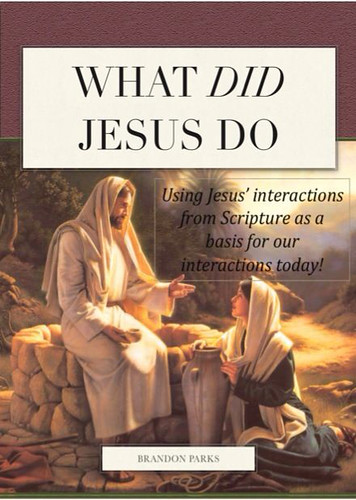
P.S. Don't forget to stop by amazon.com and purchase my book What Did Jesus Do for your kindle. It is still free for the next four days.

Sunday, April 29, 2012

Your Sins Don't Matter, You Do!

Today I want to share with you a beautiful story of the value Jesus gave someone who was otherwise criticized for her behavior. The story can be found in Luke 7:36-50 of a woman who was called a sinner, and likely was a prostitute, who came to a meal Jesus was having with a Pharisee and anointed his feet with her tears. The response from the Pharisee was one of condemnation as he said, "if this man was a prophet he would know what kind of woman this was he was letting touch him." The Pharisee immediately condemned the woman, whereas Jesus provided her with value. His response to the Pharisee was to share a story of two debtors, one who was forgiven a small debt and another who was forgiven a large debt. Jesus asked the Pharisee, "who loves more, the one forgiven a little or the one forgiven much." Of course the Pharisee's answer was the one who was forgiven much. Jesus continued by praising the prostitute's faith.

What I love so much about this story is how Jesus took a woman that was ridiculed and condemned by the religious establishment of his day, and instead provided her with value and worth. You see, that is what Jesus did. When he saw someone who was hurting emotionally or was alienated by the religious authorities, he accepted them and welcomed them into his circle where they received love and were shown a worth that they had never experienced before. We read of Jesus eating with tax collectors and sinners who were rejected by the religious elite. We read of Jesus sitting down and listening to a Samaritan woman who was criticized by her community for living with a man out of wedlock. Jesus forgave an adulteress woman who the religious elite were ready to kill, and he touched lepers whose community made to live outside the city limits. Jesus never rejected a single person he encountered, but instead brought them acceptance and love, no matter what their position was in society. Whereas the religious leaders in Jesus' time would consistently take away from the worth of others, Jesus consistently provided worth to everyone he interacted with.

What we can gain from this story is two-fold: first, you are valuable as a human being. Nothing you do can take value away from you. Your worth is based on the fact that you are part of God's creation and has nothing to do with successes or failures you have committed. Your value is safe and secure in Jesus. So when you are feeling like you have done something wrong and are feeling guilty, just know that Jesus forgives you and values you immensely. As difficult as it is to forgive ourselves sometimes, it is something we have permission to do because God forgives us without any questions asked. If you are uncertain about this, just look at the many people Jesus forgave without any hesitation. Let me say it again, you are valuable as a human being no matter what.

Secondly, we are to show people that same worth that Jesus shows us. That means when we see someone who has sinned, or who we perceive to have sinned, it is our duty not to condemn them or shun them as the Pharisee did with the prostitute. Instead our duty is to show them the forgiveness, love, and value that Jesus showed the prostitute. That means instead of judging women who have had or are contemplating having an abortion, we should show them love and acceptance. That also means that if you view homosexuality as a sin (something I myself do not) you treat them as forgiven and accept them just as Jesus would have and does. It does not matter what other people do or what their background is. It does not matter what another person's faith is, we treat them as Jesus would have: we accept them. That is what Jesus did.

Thank you, and don't forget to stop by amazon.com where you can purchase a copy of my book What Did Jesus Do: Using Jesus' Interactions in Scripture as a Basis for Our Interactions Today, for kindle. Again, thank you and God bless.

-Brandon

Monday, April 23, 2012

Jesus and the Non-Christian with Great Faith

There is a famous story which illustrates perfectly the inclusiveness with which Jesus showed to humankind while he was here; it can be found in Matthew 8:5-13 and reads thus:

5 When Jesus had entered Capernaum, a centurion came to him, asking for help. 6 “Lord,” he said, “my servant lies at home paralyzed, suffering terribly.”

7 Jesus said to him, “Shall I come and heal him?”

8 The centurion replied, “Lord, I do not deserve to have you come under my roof. But just say the word, and my servant will be healed. 9 For I myself am a man under authority, with soldiers under me. I tell this one, ‘Go,’ and he goes; and that one, ‘Come,’ and he comes. I say to my servant, ‘Do this,’ and he does it.”

10 When Jesus heard this, he was amazed and said to those following him, “Truly I tell you, I have not found anyone in Israel with such great faith. 11 I say to you that many will come from the east and the west, and will take their places at the feast with Abraham, Isaac and Jacob in the kingdom of heaven. 12 But the subjects of the kingdom will be thrown outside, into the darkness, where there will be weeping and gnashing of teeth.”

13 Then Jesus said to the centurion, “Go! Let it be done just as you believed it would.” And his servant was healed at that moment.

First off, a Centurion was a leader in the Roman military who oversaw 100 men. The Centurion was of Roman, and not Jewish heritage and would have practiced Mithraism as a religion. Mithra was a Roman god who was worshipped by the Roman military and would thus have been worshipped by this Centurion. This man with greater faith than Jesus had seen in all of Israel was therefore a pagan and did not even worship the one true God. Yet Jesus declared that his faith was greater than he had seen in all of Israel.

The first thing I want you to notice about this passage is that Jesus, knowing everything I have just stated, did not even hesitate to start heading to the Centurion's house the moment he was asked for help. Jesus did not begin to question the man about his faith, he did not ask the man for reasons why he should help him. Jesus, with no questions asked immediately began walking toward the Centurion's house because Jesus saw a need, felt compassion, and wanted to help.

Secondly, the man did not worship Jesus or become one of his disciples. He simply knew what he had heard about Jesus and went to him like anyone who was about to lose a loved one would have. His intent was not to convert to another religion or drop everything and follow Jesus. We read elsewhere that the man went back home and we presume that he went back to his normal life. And yet Jesus called his faith "great."

My reason for going through this is that Jesus did not hold back his blessing due to the Centurion's religious background or what he did for a living. What mattered to Jesus was that this man was hurting and he needed help. So Jesus felt compassion. Jesus allowed his blessing to rest on this man despite what he already believed.

Secondly, Jesus called this man, who wasn't even a part of Jesus' own faith tradition, a man of great faith. It did not matter to Jesus what god this man worshiped, or even that this man chose not to follow him after the healing; he still found it prudent to call this man's faith "great."

So what makes us as Christians so exclusive in the way we act. Why when people need help is our first question often "do you love Jesus?" It does not make much sense to me that when Jesus was so inclusive in his message, that we have become so exclusive in our message. A person can only have incredible faith if they are a Christian, according to us. And yet this man was neither a Christian nor a Jew and Jesus was able to call his faith "great."

Today we exclude people even when they are Christians. If someone is a Christ-follower but gay they are allowed no part in our services. If they come from the wrong denomination we deny them entrance into our church. And yet Jesus was able to call this strict pagan man a man of great faith.

Henry Brinton wrote a beautiful article about the welcoming table of Jesus. In it he discusses how Jesus' meal table is so large that there is always a spot open for those who wish to join. He also mentions how we have tended to shrink that table over time. I think it is time we as Christians once again work to enlarge our table to allow for a much more inclusive Church.

There are people in our community hurting and needing help, love, and compassion. When they seek these things from the Church they are often met with condemnation for one reason or another. We tend not to look past their tattoos or drug habits, their homosexuality or their foul language, their crazy hair or strange outfits. Instead we see what we disagree with and treat them with disdain. Instead, let's be more like Jesus by seeing what we have in common with them: our humanity. When we view people as human, it becomes easier to look past those things we disagree with and include them in our houses of worship. Let's show more love and compassion to all people we encounter today!

Please take the time to stop by amazon.com and purchase a copy of What Did Jesus Do for your Kindle today.

Blessings,

-Brandon

Thursday, April 19, 2012

What Did Jesus Do: The Book Release

I am proud to announce that I have finally published my book and it is available here, on the Amazon Kindle store. Currently the book is not available in print or on iBooks, but I am working on that. What Did Jesus Do? is available for $4.99 U.S. and looks good on all devices. The book description can be found below. Thank you for your support.

Blessings,

-Brandon

In What Did Jesus Do: Using Jesus’ Interactions from Scripture as a Basis for Our Interactions Today!, Brandon Parks utilizes in-depth Biblical interpretation to analyze Jesus' interactions with three groups of people in Scripture: 1. religious leaders, 2. those within Jesus' discipleship, and 3. those outside Jesus' discipleship. Using this information, Brandon gives the modern day Christian guidelines for interacting with similar groups of people today. With this information, Christians can foster better relationships with people and learn ways to interact with people that are more in line with the way Jesus interacted with people in his day.


Thursday, March 15, 2012

What Religion Am I?

For many of you the answer to the title question may seem obvious; you would say I am a Christian. If you had asked me a year or more ago what religion I belong to, I would have said Christian also. But I'm not sure this label fits me anymore, and let me tell you why: it is because I do not believe that Jesus himself accepted any labels for himself, and I believe that labels represent everything that Jesus was against. It creates a me-against-them mentality that Jesus was adamantly opposed too. Search in the Bible and tell me where Jesus claims a religion for himself. You can't because he doesn't. Sure, Paul labels himself a Jew, but the famous mantra is not "what would Paul do" but "what would Jesus do," and Jesus did not accept labels.

I do not want anyone to be mistaken; I believe in Jesus, I read the Bible, and I pray to God. But I am open to people of other faiths. I make no attempt to convert people from their belief to mine. How arrogant is it of me to say "I am right and you are wrong." Instead, I want to be like Jesus who accepted the Mithra worshipping Centurion who had more faith than anyone in Israel (Matthew 8:5-13). I want to be like Jesus who accepted the pagan Gentile woman with whom he had the longest dialogue in all of Scripture whose faith was so great (Matthew 15:21-28). Jesus applauded these people who worshipped a different god than he did, yet ridiculed the religious leaders of his day who belonged to his own religion.

By claiming a religion, I am doing that which Jesus worked so hard against: building boundaries. Jesus worked to tear down the boundaries that his religious group set up. His religious group set up boundaries between those who were clean and those who were unclean. Lepers could not remain in the city or have any contact with their family or friends. They were required to remain on the fringe of the city. Jesus allowed for them to reenter once he healed them. The clean were not supposed to dine with the unclean, yet that is exactly what Jesus did, and he was rebuked for it. Yet he wanted to establish that there was no boundary to be placed between the clean and unclean. Jesus overthrew the moneychangers at the Temple in Jerusalem because of the broken Temple system which created such boundaries that the farther in you go into the Temple, the less types of people were allowed in, until finally only the high priest could enter into the Holy of Holies. It was upon Jesus's death that the curtain of the temple was torn, thus tearing down the final boundary that was established by the Jews between humankind and God.

Now, think about the kind of boundaries one is setting up by calling themselves Christian. They are placing themselves in a position opposing other groups, such as Jews, Muslims, Hindus, and Buddhists. The immediate connotation that enters the head of one who hears that someone else is a Christian is, "oh, he/she thinks they are right and I am wrong." Immediately there is a sense that that person has that he/she needs to defend him/herself. One then turns to think of all of the cruelty that has been done in the name of Christianity. It is rare anymore for a non-Christian to hear the label "Christian" and think in positive terms. Instead the term works to build walls instead of bridges. To conclude, I do not know what to call myself, but I can no longer call myself a Christian. I do not deny Jesus the Christ. What I do denounce is this label which has become a term not of respect, but of derision.
Sincerely,
-Brandon

Tuesday, November 9, 2010

Christians: Take Responsibility So You can be the Cure

It is the greatest feeling to finish another chapter, and I just finished the fifth chapter in my book, discussing how Christians today should interact with contemporary outsiders. One area where our interactions have fallen short of the desire of Christ, is in our interactions with the gay, lesbian, bisexual, and transgender crowd. Ask anyone on the street what the Christian perspective on homosexuality is, and they will say Christians view homosexuals as sinners who are going to hell. This comes from the outspokenness of Christians about gays being responsible for all of the tragedy's that have taken place in the last ten or more years. 9/11 was blamed on the gay population, Katrina was blamed, the death of American soldiers over seas is blamed for the homosexuality in America. Christians have a bad reputation when it comes to how we interact with the gay population.

Jim Daly has a wonderful article entitled "My Take: Christianity not to Blame for Anti-Gay Bullying" in which he says that Christianity is the cure for this type of anti-gay treatment of homosexuals. He is referring to the recent suicides of some gay teenagers that made the news last month. I agree with Jim that Christianity, as it was meant to be, is the cure. But I highly disagree (can one mildly disagree I wonder) with him that Christianity is not to blame. I think the biggest problem is that the Church is not standing up and taking responsibility for itself. The blaming of homosexuals for the recent disasters in our country was done by prominent church leaders, not merely nominalist Christians. If Christians cannot stand up and take at least some of the blame for the anti-gay treatment, taking responsibility for its part, it will never be able to take the position as the cure for the accepting of gays and lesbians. When Christian leaders can stand up and say, "we are sorry for preaching hatred and judgment against homosexuals, and we ask for your forgiveness so we can begin the healing process," Christians can then begin to be the cure by exemplifying Christ Jesus in showing long deserved love and compassion to the gay and lesbian, the bisexual and transgender population of the United States. This is what Rev. Mark Tidd, Sr. Pastor of the Highlands Church in Denver, Colorado did. You can read about his remarkable transformation in a blog entitled Evangelical Changes His Views on Homosexuality and Church Grows as a Result. This pastor was deeply effected when he experienced first hand the love God had for a family with a gay child in his congregation. He changed his views and his church grew from 80 to 300. That is a stamp of approval from God on this pastor and his change of belief if I ever saw one. Remember, God loves and embraces all of humankind, whether it be straight or gay, black or white; He accepts all who desire to enter into His kingdom.
God bless.
-Brandon